This month the spotlight was on the volunteer Grove Guild Stitchers as we came together to appreciate the tremendous contribution they made to the 2026 Grove Theatre season. We learned what makes these sewers tick and stitch by listening to their stories as they walked us through the many costumes and props they brought to share with Guild members. In the end, we were able to witness the dynamic role that collaboration and respect played among this dedicated team.
We began the conversation by sharing our collective thoughts on the vital role that costumes play in the theatre. Together we brainstormed that they:
● Help identify a character’s personality, status and background (think King Arthur in Spamalot).
● Give historical and cultural context (think how Doris’ costumes in Same Time, Next Year reflected of the styles of the times).
● Create mood and atmosphere (think 70s Dance Party) and,
● Create visual cohesion, working together with lighting and set design, to form a language that supports the artistic director’s and costume designer’s shared vision.
All this before a single word is spoken on stage! We added that costumes must help shift actors into their characters’ roles making them feel dynamic and real. In summary, costumes help tell the story.
The names of this glorious group of Stitchers are: Catherine Beagan, Mary Jane Brennan, Christine Cambridge, Marnie Deathe, our own Guild member Marilyn Dixon, and finally, Antoinette Larrizza. As they introduced themselves, we learned that they all came to The Grove as skilled sewers, that most of them have been with The Grove for more than one season, and that each of them volunteered an incredible number of hours—most in excess of 200 hours in this past season alone. We quickly began to understand how close these women have become, how much fun they had, and the essential role they play in helping The Grove Theatre come alive.
In addition to their clear bond and the fun they had working together, what became apparent was the respect and appreciation they felt, and received, from Production Manager -Allison Bjerkseth, Costume Designer – Andrew Nasturzio, and Head of Wardrobe - Sarah Grindall. They were approachable and together fostered an open, inclusive environment which was an integral part of the Stitchers’ experience. Unlike in other theatres, their ideas were welcomed, and were considered as part of the on-going problem-solving. Andrew constantly praised their work as “fabulous…, fabulous.” Allison stressed how “very, very, very, gracious and lovely,” it was to work with them, repeatedly referring to them as her “angels.”
They discussed their move from their original workspace at The Grove box office to the middle room in the United Church basement. Both brought different opportunities. At the box office, patrons came in and saw their work in-progress, which initiated a type of awareness to what goes into bringing productions to life. In the church, they were surrounded by the Grove’s rehearsal hall, which also had its advantages; it helped them feel even more included, as they were amongst the action. At times they found themselves singing along during rehearsals; they had some interaction with the cast, and they had easy access to staff and directors—they felt part of the show!
The Stitchers shared their process: they started in January as part of Allison’s team. Under her guidance, they began working on props for Spamalot. Catherine explained that early on, they communicated with Andrew through video chat, where he showed them conceptually what was going to be done for Spamalot (which we know was the driver for the season). They worked on the cow (more on that shortly!) and, from a photograph, the fish (they made 18 of them but only 6 were used). They made the fun sequined shorts worn by the minstrels in Spamalot. Then they quickly moved into Same Time, Next Year, and 70s Dance Party. They did some smaller jobs for Canadian Legends Vol. 2, as most of the costumes were reused from last year. Andrew and Sarah came on board in May.
We were surprised to hear they also made cooling vests with inner pockets for cold packs that the performers could wear under their costumes in the intense summer heat…
Notwithstanding their 200+ volunteer hours, their schedule seemed flexible, at least up until June, when everyone was driven to make everything come together for opening night. Mary Jane described their “middle room” in the church, set up with tables, sewing machines, sergers, and a single iron. We were surprised when Marnie shared that they do not do fittings, and never “touched” a performer. Working with a performer in costume; that was Andrew and Sarah’s responsibility. Their main job was to make the costumes. Typically, they began with a photo and a chart of measurements, which Marnie pointed out were not accurate - sparking laughter in the room.
The work they chose to do was also flexible—they could pick what they wanted to work on. Garments were hung up for them with instructions as to what needed to be done. For efficiency, they worked with a colour-coded priority system, which was developed by Allison. We also learned that sewing costumes was mostly a collaborative effort. They could drop in for three hours to work on a costume and hang it back up for the next sewer who came in, so a single costume may have been sewn by three of them. At times they might tackle something challenging; at other times they might only have a couple of hours to get a smaller job done. They got to choose their own adventure on a daily basis.
Closer to show time, they would be asked to do specific alterations. For instance, a memo might ask them to take in a garment by eight inches, but leave the fabric intact so it could be let out, or to take the hem up 2 inches and raise the shoulders. They put their name on a job that was done, and when a piece was complete, they would sign off on it.
Christine explained that sewing costumes is very different than sewing street clothing. In street clothing, an item should fit nicely and be beautifully tailored to last. In sewing costumes, they work with the “5-Foot Rule,” meaning that a garment should look good from 5-feet away. Letting go wasn’t easy for them. When asked to take in a garment, but leave the fabric intact, the difficulty lay in making it “smooth and nice.” Often, extra fabric is left so a costume can be taken in or let out, which also means that it needs to be constructed so it can easily be taken apart. So, they sew with a “built-in contingency plan,” approaching a costume so that it can be re-used, or constructed for quick changes (magnets were used for this purpose!). For expert sewers, this is difficult because, as Christine said, when you sew you want an article to be beautiful on the inside too. They had to come to terms with a GEMO mindset (Good enough, move on), which was very fitting, no pun intended!
Not every costume was made from scratch. Some were borrowed from another theatre. Some garments were bought from the internet to be modified or transformed into a whole new costume. The Stitchers shared many examples with us here—some pieces were torn apart; some were added on to. In one instance, eight pink ruffled dresses were ordered when they needed six. The extra two were taken apart to modify some of the six. For example, a ruffle needed to be added to one of the dresses for a taller performer.
Some items were totally invented. Catherine told the story of how the fitted orange and pink shawl on display came to fruition for 70s Dance Party. The Stitchers didn’t think Allison’s vision was going to work. The reason? The project started as a shower curtain (this prompted tremendous laughter from Guild members!). The Stitchers struggled, but Allison pushed them and pushed them, and the result was smashing. We as the audience could never have guessed.
Marnie told the story of how the famous comedic cow prop came together for Spamalot, one of their early challenges. They started with a crude pattern on an 8 1/2 x 11 piece of paper with instructions in Russian (still more laughter) and, using a projector, blew it up, added an udder to a male cow, and worked from there. She said they thanked Allison for that nightmare (which again led to a roar from the audience). So, we were beginning to figure this out: there was lots of ingenuity, learning and problem solving going on!
We could see, the Stitchers were faced with many challenges, and we were beginning to appreciate the level of expertise this group had—especially when we asked each of them to talk about a piece on display, they were particularly proud of. There was the elaborate boa Mary Jane made from 50 yards of silk organza that Andrew told her to go home and YouTube; there was the project Christine undertook that entailed fabricating a white dress with layers of crispy sequined fabric that took immense patience to work with.
Together, Marilyn, and Mary Jane constructed King Arthur’s royal tabard (in fact, they made all the tabards). Andrew had sent Marilyn the design and said, “can you do this?” Using AI and a 3-D printer, she figured it out. Marilyn cut out all the designs, pieced them all together and painstakingly sewed in the appliqué. Mary Jane stitched in the lightweight plastic chain sleeves designed by the 3-D printer (ordered from the internet) … Catherine made the amazing vest that Doris wore in Same Time, Next Year. She hand-quilted every little square and cut out the vest, a total of 150 pieces (!) … Marnie sewed the exquisite, beautifully tailored gold shirts worn by Isaac. Christine emphasized how difficult it is to sew shirts, adding that that’s what money is for (we all laughed at that). In a nutshell, we found their work to be mindboggling. Aside from their talent, we were able to see how supportive these gals are towards each other, and how they were able overcome technical challenges. We were all in awe of the Stitcher’s work, and we loved their light-hearted spirit.
Christine wanted us to know that as much as their work appears glamorous, much of it is not. Cutting out never-ending squares for tabards and working with 600 yards of ruffles that had to be “endlessly surged and gathered” proved to be most tedious projects. And there were the cut and folded ribboned sleeves (each sleeve had approx. 100 ribbons in it) that took three of them to finish. When the going got tough, they would huddle and ask: “How would you do this, how would you tackle that?” they asked each other. Together they would brainstorm and work with the supplies they had.
The women referred to themselves as drivers, it was definitely evident. They all took on projects that they never would have touched normally, and could never have envisioned. When asked about what their first thought was the first time they saw their work on stage, they all said “Wow”! They could hardly believe how it all came together. They were so proud!
It became obvious to us how the Stitchers endured last season, and why they keep coming back as volunteer sewers. They earned the respect of the professional team they worked with; they respected each other and each other’s sewing capabilities; there was zero ego involved (ha! they could have made use of the extra battle fish from Spamalot, but no need). They shared the common goal of wanting Allison, Andrew and Sarah to be successful, especially during the intense 4 weeks leading up to opening night, when they took projects back and forth from home to meet the deadline.
They were in awe of Andrew’s creative mind and the designs he came up with. They learned a lot together—from patterns, from each other; they were challenged through working with more difficult materials such as sequins, and repurposing cheap tablecloths into fancy-layered belled sleeves. Importantly, they bonded, had a lot of fun working together, and supported each other and each other’s work. This was quite unlike the absurd, dysfunctional, and self-absorbed King Arthur’s and his Knights of the Round Table in Spamalot! Through endless collaboration and sticking and stitching together they figured everything out.
Praise for the Stitchers, they certainly earned their title from us, with a capital S! We all had a lot of fun learning from them. Congrats to Guild prize winners Sharon Howard and Diane Brock for winning our numbers game. The answer to the question: “How many pieces were the Stitchers responsible for last season?” was 242. Their answers were 240 and 252, respectively. Nice work!
Your Co-chairs,
Brenda Devine & Pj Murray
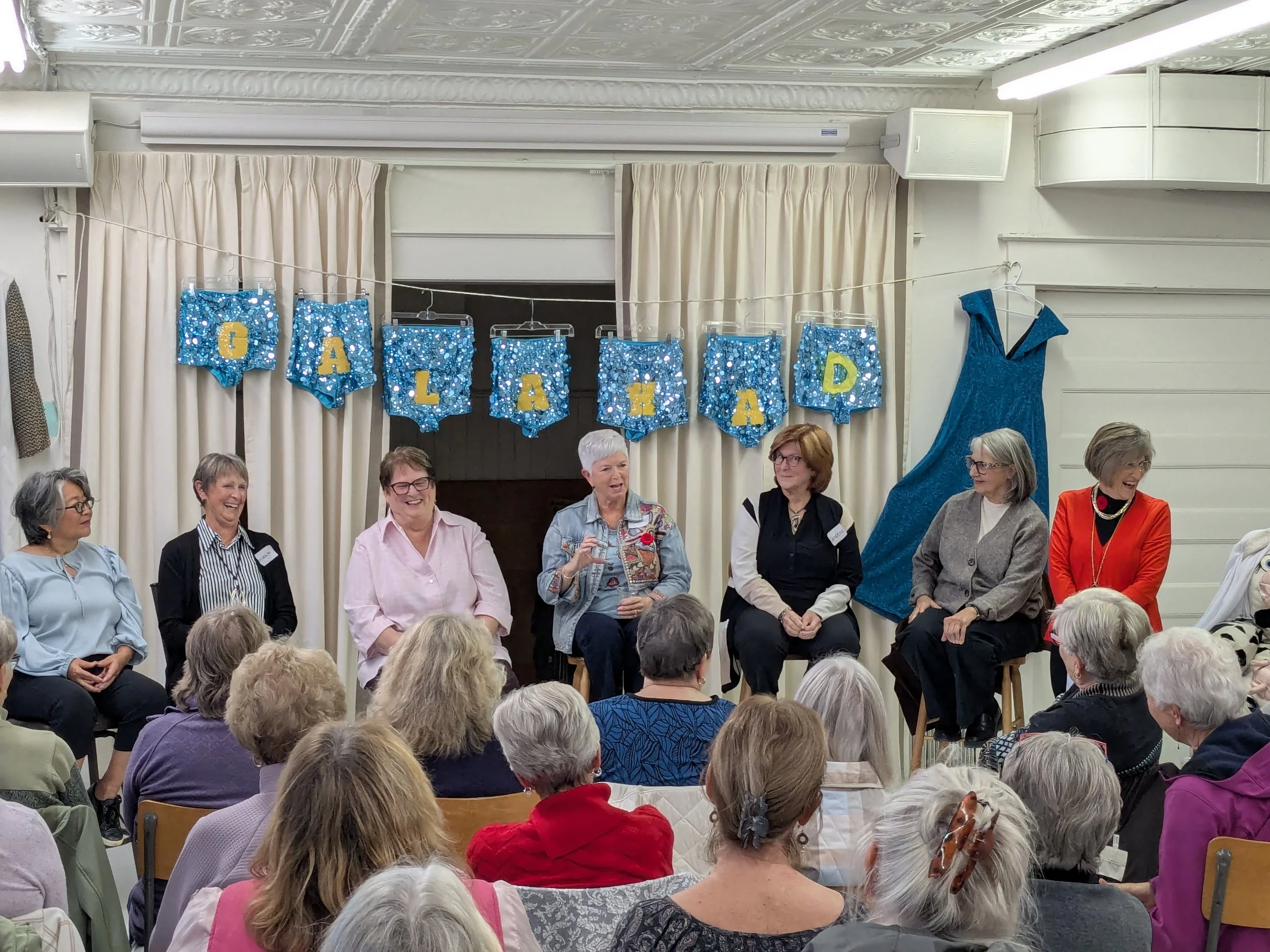
The Grove Stitchers